

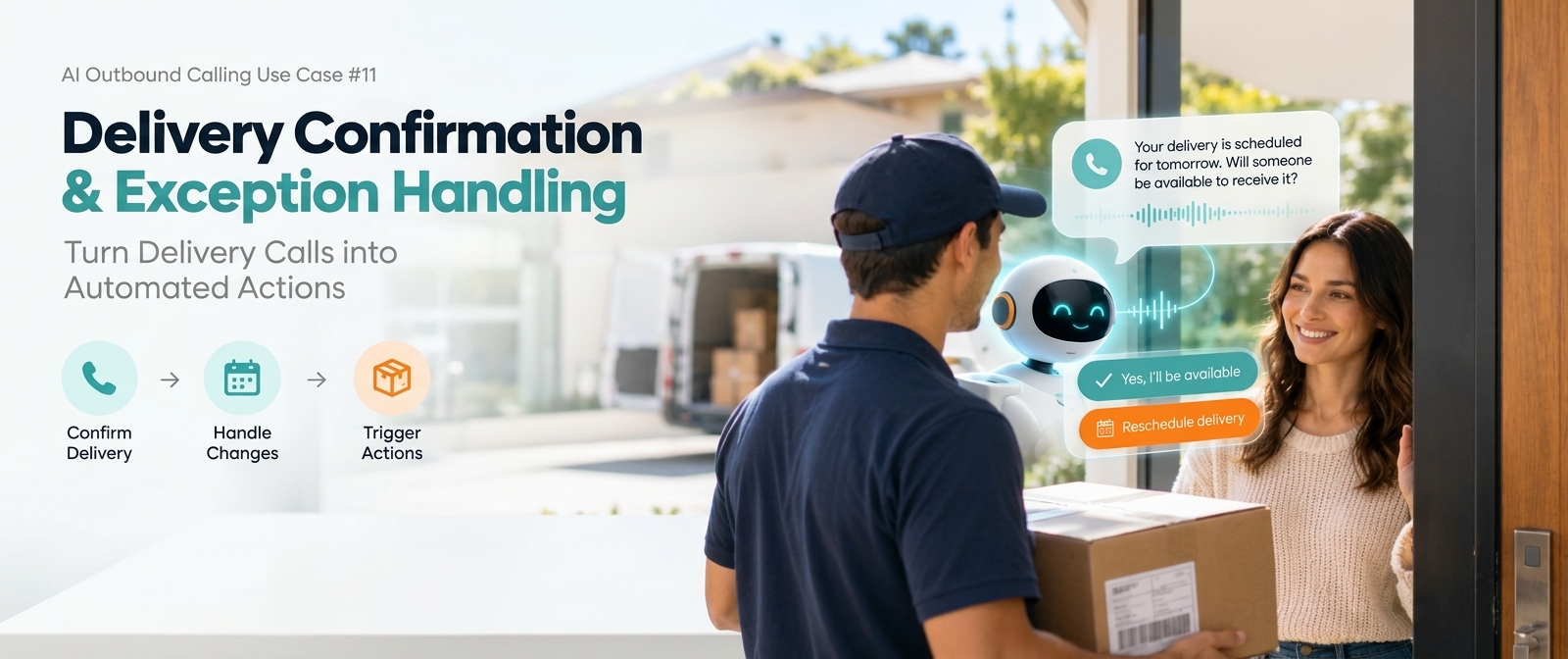
Turn Delivery Calls into Automated Actions
Delivery Confirmation & Exception Handling
Turn delivery calls into automated actions with proactive availability checks, instant rescheduling, and closed-loop dispatch workflows.
A package is out for delivery. But is the customer available to receive it?
The address might be incorrect. The customer may need to reschedule. Or the driver could arrive when nobody is home.
For logistics and delivery companies, these small issues can lead to failed deliveries, additional costs, and frustrated customers.
The challenge isn't just notifying customers. It's resolving delivery issues before they become bigger problems.
This is where AI outbound calling can help.
AI voice agents can proactively contact customers, confirm delivery arrangements, identify potential issues, and trigger follow-up actions automatically.
01 1. Why Delivery Confirmation Matters
Delivery operations involve thousands of customer interactions, many of which are repetitive but time-sensitive.
Common challenges include:
- Failed deliveries: Customers are unavailable or delivery details are incorrect.
- Last-minute changes: Customers request different delivery times or locations.
- Limited visibility: Dispatch teams discover problems too late.
- Manual follow-ups: Staff spend hours calling customers to confirm basic information.
Every unresolved issue can result in additional delivery attempts, operational costs, and customer dissatisfaction.
02 2. How AI Outbound Calling Helps
Automated Delivery Confirmation
AI voice agents can call customers before scheduled deliveries to confirm their availability.
For example:
“Your delivery is scheduled for tomorrow afternoon. Will someone be available to receive it?”
Customers can confirm the delivery or request changes during the conversation.
Identify Delivery Exceptions
Not every delivery goes as planned.
AI can identify common exceptions, including:
- Customer unavailable
- Incorrect or incomplete address
- Request to reschedule
- Special delivery instructions
- Delivery delays or complaints
Instead of simply recording the response, AI can classify the issue and initiate the appropriate workflow.
Trigger Automated Actions
Based on the customer's response, AI can trigger actions through connected logistics systems.
| Customer response | Automated action |
|---|---|
|
✅ Delivery confirmed
|
Update delivery status |
|
⏳ Customer unavailable
|
Initiate rescheduling |
|
📍 Address correction needed
|
Request verification |
|
📝 Special instructions
|
Notify dispatch team |
|
⚠️ Delivery complaint
|
Escalate to customer service |
Actions requiring approval or identity verification can be routed to the appropriate team.
Escalate Complex Issues to Humans
AI can handle routine confirmations, while human agents manage complicated exceptions.
For example, if a customer disputes a delivery, reports a missing package, or requires urgent assistance, AI can transfer the case to a human agent with the conversation context.
AI handles routine communication. Humans focus on exceptions that need judgment.
03 3. How It Works
A typical workflow looks like this:
For example:
A logistics company schedules 2,000 deliveries for the following day.
Instead of manually contacting every customer, AI voice agents can initiate confirmation calls based on delivery schedules and calling rules.
Customers who confirm their availability require no further intervention.
Those requesting changes can be routed into rescheduling workflows, while complex issues are flagged for dispatch or customer service teams.
The result is a more organized delivery process with fewer repetitive calls for employees.
This is an illustrative workflow, not a reported customer deployment or performance result.
04 4. Where It Works Best
🛒 E-commerce & Last-Mile Delivery
Confirm customer availability, delivery windows, and special instructions before dispatch.
🚛 Logistics & Freight
Notify customers about shipment arrivals, confirm unloading arrangements, and identify potential receiving delays.
🛋️ Furniture & Appliance Delivery
Coordinate deliveries that require customers to be present, including large-item deliveries and installation appointments.
🏢 B2B Distribution
Confirm warehouse receiving schedules, delivery requirements, and contact availability.
05 5. Measure Delivery Outcomes, Not Just Calls
The value of AI outbound calling should be measured by operational results.
Useful metrics include:
Percentage of deliveries confirmed before dispatch.
Percentage of contacted deliveries with identified issues.
Percentage of deliveries completed on the first attempt.
Percentage of requested changes successfully processed.
Reduction in routine calls handled by employees.
These metrics help logistics companies understand whether automated communication is improving delivery operations.


