

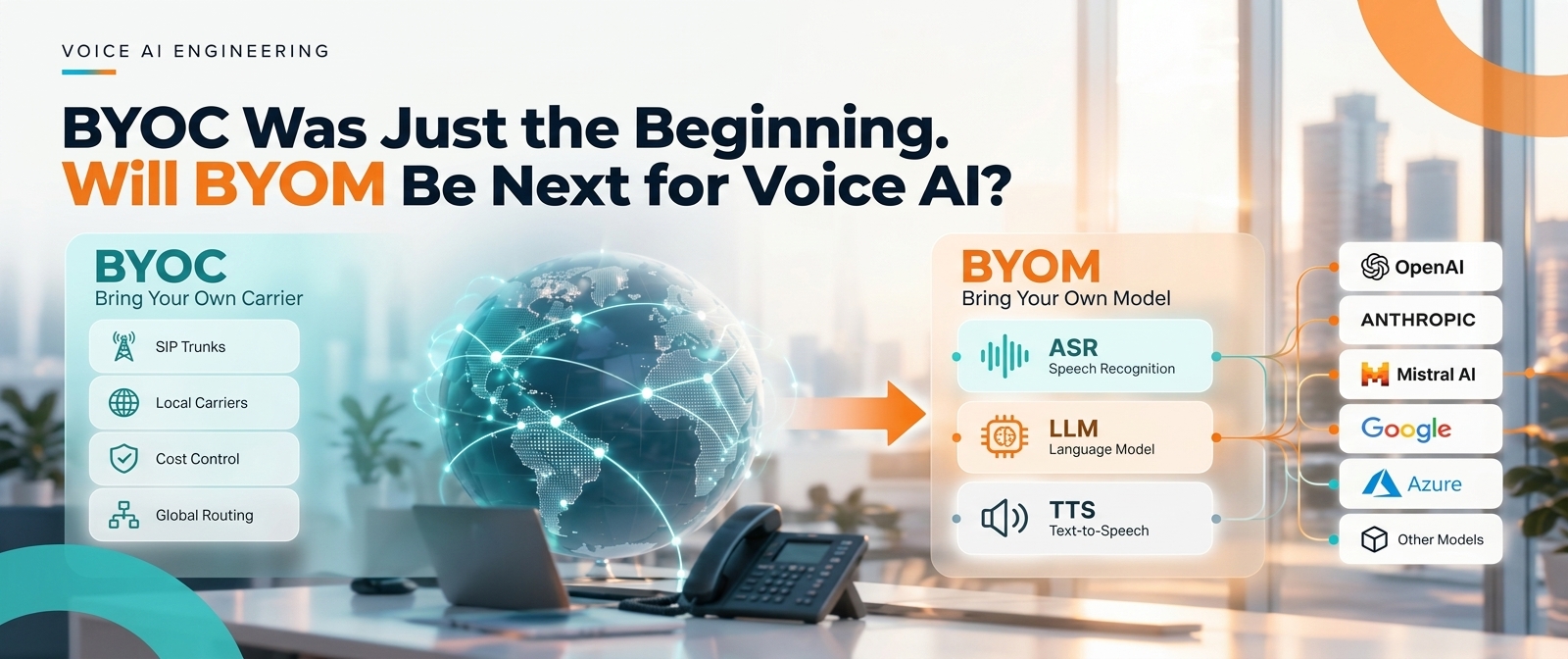
BYOC
Bring Your Own CarrierBYOM
Bring Your Own ModelEnterprises wanted the freedom to choose their own carriers. Now they may want the same freedom with AI models.
For years, businesses deploying contact centers have valued BYOC (Bring Your Own Carrier).
Instead of being locked into a platform's telephony provider, enterprises can connect their existing SIP trunks, manage carrier relationships, and optimize call routing based on geography, pricing, and reliability.
Now, a similar conversation is emerging in Voice AI.
As speech recognition, large language models, and text-to-speech technologies evolve rapidly, businesses face a new question:
Why should an AI voice agent be tied to a single model provider?
This is where BYOM — Bring Your Own Model — becomes interesting.
And it could reshape how enterprise Voice AI platforms are built.
1 Why BYOC Became Important
BYOC gives enterprises more control over their telephony infrastructure.
A multinational company might use different carriers for North America, Europe, and Asia.
Each carrier may offer different advantages in terms of:
- Local number availability
- Call termination costs
- Network quality and routing
- Regulatory requirements
- Redundancy and failover
With BYOC, businesses can maintain their carrier relationships while using a separate contact center or AI platform.
But BYOC doesn't automatically guarantee full portability.
Outbound calling, caller ID presentation, transfers, callbacks, and failover still depend on how the platform integrates with each carrier.
The underlying principle is straightforward:
Enterprises want flexibility without rebuilding their entire communication system.
The same principle may increasingly apply to AI models.
2 The Voice AI Stack Is Becoming More Modular
A typical cascaded AI voice agent includes three major model components:
- ASR (Automatic Speech Recognition) converts spoken language into text.
- LLM (Large Language Model) interprets the conversation, reasons about the next action, and interacts with business systems.
- TTS (Text-to-Speech) converts the response into natural speech.
These components don't necessarily need to come from the same provider.
For example, an enterprise might prefer one ASR model for Spanish conversations, another LLM for complex reasoning, and a specialized TTS engine for a particular brand voice.
This creates opportunities to optimize the system around specific business requirements.
However, cascaded architecture is not the only option.
Speech-to-speech models can process audio more directly, potentially reducing latency and preserving conversational information that may be lost during transcription.
The trade-off is that some integrated speech models offer less flexibility to replace individual components.
The architectural decision is no longer simply which model is best. It's how much control the enterprise needs over the entire voice pipeline.
3 BYOM Is Already Becoming a Real Architecture
Two recent developments illustrate this shift.
Microsoft: Bring Your Own Model with Voice Live
Microsoft's Voice Live API supports BYOM configurations that allow enterprises to use supported model deployments within their Azure AI environment.
These can include different language models, custom deployments, and certain third-party models available through Microsoft Foundry.
The voice service handles speech interaction capabilities while the enterprise selects an appropriate model deployment.
This separation gives organizations more flexibility over model selection, throughput, and configuration.
However, Microsoft's BYOM approach is not equivalent to unrestricted self-hosting. Model availability and deployment options remain subject to the supported Microsoft Foundry environment.
Mistral: Voxtral 3 and Modular Voice Agents
On October 20, 2026, Mistral introduced Voxtral 3, a family of speech models and a Voice Agent SDK.
The SDK connects speech recognition, reasoning, tool calling, and speech generation in a real-time streaming pipeline.
Mistral says developers can change the LLM, voice, or language without rewriting the entire agent.
It also supports integration with telephony systems through SIP and browser-based applications through WebRTC.
This is an important architectural direction.
The conversation runtime can become more independent from the models that power it.
For enterprises, that could mean greater flexibility to adopt new AI capabilities as they become available.
4 Why Enterprises May Want BYOM
Better Performance Across Languages
No single model performs equally well across every language, accent, and acoustic environment.
A voice agent operating in English, Arabic, Spanish, and Hindi may face very different recognition and pronunciation challenges.
Model flexibility allows enterprises to evaluate and select technologies based on actual performance in each target market.
More Control Over Costs
Model pricing varies considerably.
Mistral's Voxtral 3 announcement, for example, lists its hosted Voice Agent API at $0.04 per minute with Mistral Small 4 for reasoning, or $0.08 per minute with a larger model.
These are published service prices, not the total cost of operating an AI call center. Telephony, carrier charges, integrations, monitoring, and infrastructure may add further costs.
Still, model flexibility could allow businesses to use less expensive models for routine tasks and more capable models when additional reasoning is required.
Reduced Dependency on One Provider
AI models evolve quickly.
A model that performs well today may be surpassed by another in accuracy, latency, language support, or price.
BYOM could reduce the effort required to adopt newer models without rebuilding the complete application.
Data Control and Deployment Flexibility
Some organizations need greater control over where customer audio, transcripts, and business information are processed.
Depending on the provider, model licensing, and architecture, enterprises may be able to choose regional hosting, private-cloud deployments, or self-managed infrastructure.
However, BYOM does not automatically guarantee data residency or regulatory compliance. These requirements must be evaluated across the entire system.
5 BYOM Is More Complicated Than Switching an API Key
Model flexibility sounds attractive.
But replacing a model inside a production voice agent introduces technical challenges.
Latency and Turn-Taking
Different models have different response characteristics.
A model change can affect first-token latency, streaming behavior, interruption handling, and the overall conversational experience.
A model that performs well in text-based testing may behave differently during live phone calls.
Tool Calling and Business Logic
AI voice agents frequently interact with CRM systems, scheduling tools, payment platforms, and other applications.
Different LLMs may produce different tool-calling behavior.
Replacing a model therefore requires testing whether it still follows business rules and executes actions correctly.
Prompt Compatibility
Prompts and agent instructions are not always portable.
A prompt optimized for one model may behave differently with another.
Enterprises need regression testing to verify that model changes don't introduce unexpected behavior.
Observability
When a conversation fails, engineering teams need to determine whether the issue originated in speech recognition, reasoning, speech synthesis, tool execution, or telephony.
Without adequate monitoring, model flexibility can increase operational complexity rather than reduce it.
Security and Governance
Every model must operate within the same authorization boundaries.
Changing the LLM should not change which customer records an agent can access or which business actions it can perform.
True BYOM requires more than model compatibility. It requires a stable execution and governance layer around the models.
6 What Could a BYOC + BYOM Architecture Look Like?
Consider a multinational company running AI outbound campaigns.
Its communication infrastructure might include:
- Carrier A for North America
- Carrier B for Europe
- Carrier C for backup routing
Above that sits an AI voice platform responsible for:
- Campaign management
- Call control and routing
- Conversation state
- Business workflows
- CRM integration
- Human escalation
- Monitoring and analytics
The model layer could then include:
- ASR Model A for English
- ASR Model B for Spanish
- LLM A for routine customer interactions
- LLM B for more complex reasoning
- TTS models selected by language or voice requirements
This is an illustrative architecture, not a description of any specific vendor's current implementation.
In a well-designed system, the enterprise could change a carrier or model without redesigning every other component.
But maintaining that flexibility requires clearly defined interfaces, consistent data structures, testing, and operational controls.
The real value lies in separating infrastructure choices from business workflows.
7 Will BYOM Become a Standard Enterprise Requirement?
Not every business needs BYOM.
For smaller organizations, an integrated AI voice platform may offer faster deployment, simpler management, and fewer integration responsibilities.
A single provider can be a perfectly reasonable choice when it meets the required performance, cost, and compliance standards.
But larger enterprises may increasingly ask for more flexibility.
Especially when they operate across multiple countries, process sensitive customer information, or run high-volume voice automation.
The competitive advantage may shift toward platforms that can combine:
That doesn't mean enterprises will constantly switch models.
It means they will have the option to do so when business requirements change.


