

For years, sales teams have heard the same prediction:
Cold calling is dead.
Email, LinkedIn, social selling, and inbound marketing have all changed the way businesses reach prospects.
But the data tells a different story.
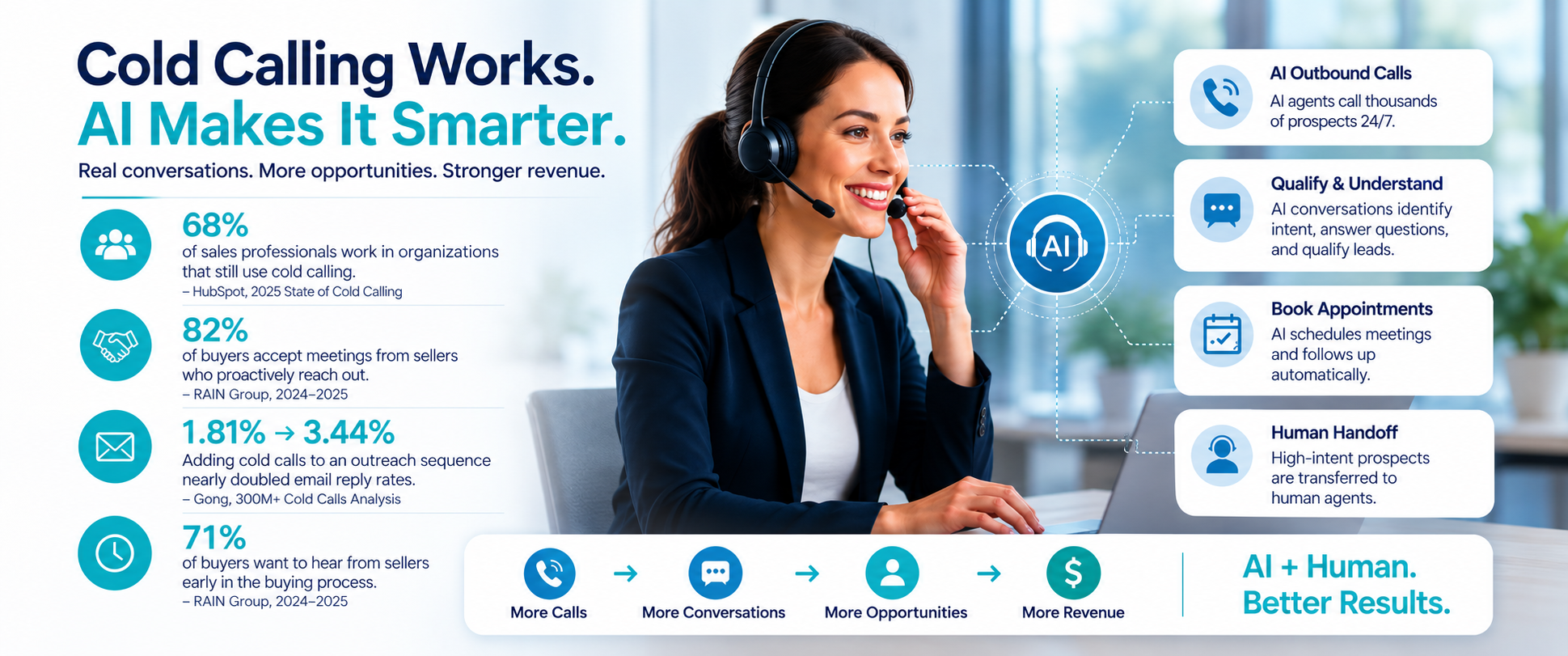
According to HubSpot's 2025 State of Cold Calling report, 68% of sales professionals work in organizations that still use cold calling.
RAIN Group research also found that 82% of buyers accept meetings with sellers who proactively reach out, while 71% want to hear from sellers early in the buying process.
So maybe cold calling isn't dead.
Maybe the way we do it is changing.
Why Cold Calling Still Works
Cold calling has one advantage that many digital channels don't:
It creates a real conversation.
An email can be ignored.
A LinkedIn message can sit unread.
An advertisement depends on someone clicking.
A phone call gives salespeople an opportunity to immediately:
And the conversation itself provides valuable information.
A prospect saying:
“We're interested, but our contract doesn't expire until next year.”
isn't simply a rejection.
It's a future sales opportunity.
Cold Calling Can Also Strengthen Other Channels
Cold calling doesn't have to compete with email or LinkedIn.
It can work alongside them.
Gong analyzed more than 300 million cold calls and found that adding calls to an outreach sequence increased email reply rates from 1.81% to 3.44%.
The lesson?
The best outbound strategy may not be one channel.
It may be:
Each channel plays a different role.
The Problem With Traditional Cold Calling
If cold calling works, why do so many sales teams struggle with it?
Because human-powered calling doesn't scale easily.
Salespeople spend a significant amount of time:
Many of these activities are repetitive.
And every hour spent on low-value calls is an hour a salesperson isn't spending on:
Discovery. Negotiation. Relationship building. Closing.
That's where AI outbound calling changes the equation.
AI Doesn't Replace Cold Calling. It Automates It.
AI voice agents can handle the repetitive part of outbound calling:
When a prospect shows strong buying intent or needs a more complex conversation, AI can transfer the call to a human agent.
The model becomes:
AI handles the volume.
AI identifies the opportunities.
Human agents handle the high-value conversations.
Salespeople focus on closing.
Cold Calling + AI = A New Outbound Model
The goal of AI outbound calling isn't simply to make more calls.
It's to make human sales capacity more valuable.
Instead of asking:
“How many calls can my sales team make today?”
businesses can start asking:
“How many prospects can we engage, qualify, and move toward a sales conversation?”
That's a much more powerful combination than either one working alone.
Cold Calling Isn't Dead
The phone isn't being replaced by AI.
The phone is becoming an AI-powered sales channel.
Cold calling is evolving from:
The companies that win with outbound sales won't necessarily make the most calls.
They'll create the most effective system for turning calls into conversations, conversations into qualified opportunities, and opportunities into revenue.


