

Stop Measuring AI Voice Agents by Calls Handled — Measure Business Outcomes Instead
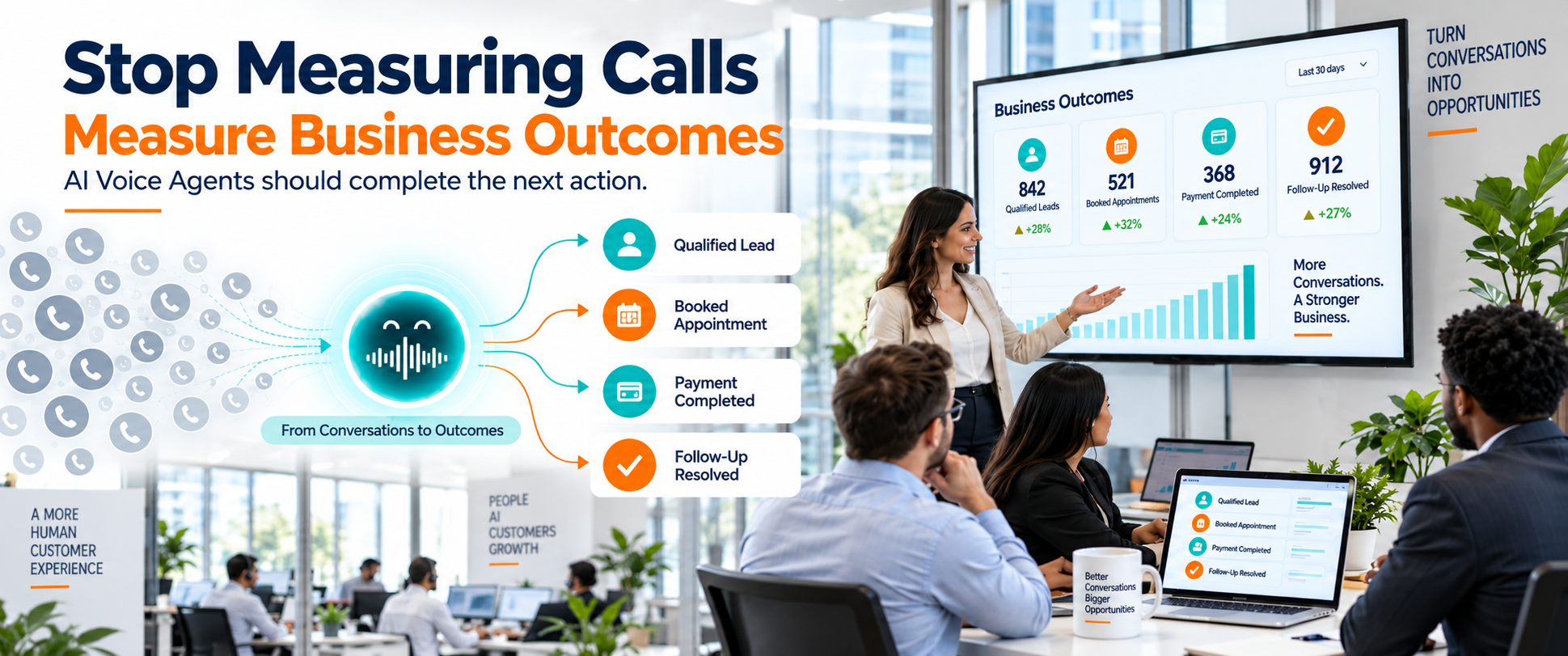
20,000 AI-powered calls sounds impressive.
But how many of those calls actually resulted in something?
A qualified lead. A booked appointment. A completed payment. A successful customer follow-up.
As AI Voice Agents become more common in contact centers, businesses may need to rethink how they measure success.
The most important KPI may no longer be how many calls AI can handle.
It may be how many business outcomes AI can complete.
Contact Center AI Is Entering the ROI Era
The industry conversation around AI is changing quickly.
According to theCUBE Research, 92% of organizations now have AI integrated into at least one stage of their operations, up from 71% in early 2024.
But adoption alone is no longer enough.
At the September 2026 AI ROI in Contact Centers Summit, the focus has shifted toward measurable metrics such as cost-to-serve, agent productivity, resolution quality and customer experience.
The question is moving from:
to:
This matters because an automated conversation is not necessarily a successful conversation.
If an AI agent completes a call but the customer calls back later, a salesperson still needs to manually update the CRM, or the next action never happens, the business value of that automation is limited.
From Call Metrics to Outcome Metrics
Traditional contact centers have relied heavily on operational KPIs:
- Calls handled
- Average handling time
- Cost per call
- Automation rate
- Qualified Leads Generated
- Appointments Confirmed
- Payments Completed
- Opportunities Created
These metrics still matter, but AI Voice Agents make it possible to measure something more valuable.
For outbound calling, businesses can increasingly focus on outcomes such as:
This changes the role of AI outbound calling.
The goal is no longer simply to automate conversations at scale.
The goal is to move customers toward the next business action.
The Industry Is Already Moving in This Direction
This shift can be seen across the Contact Center industry.
Genesys recently introduced new agentic orchestration capabilities designed to coordinate AI, people and business systems from customer intent through to outcome.
Instead of treating AI as an isolated bot, the platform connects AI Agents with customer context, workflows and enterprise systems.
Salesforce research also shows why this matters.
A recent study of more than 2,000 Agentic AI leaders found that organizations deploying AI agents reach meaningful ROI in approximately eight months on average. Salesforce identified clean and accessible data, clearly defined AI Agent scope and established human escalation paths as important factors behind successful deployments.
The message is increasingly clear:
The AI model alone does not create ROI.
Integration, workflow design and measurable outcomes do.
What This Means for AI Outbound Calling
Consider a typical lead qualification campaign.
A basic AI calling system might:
An outcome-driven AI outbound workflow goes further:
The difference is important.
If an AI Voice Agent discovers that a prospect is interested, the workflow should not end with a call disposition marked “Interested.”
It should be able to trigger the next step — update the CRM, schedule a meeting, notify the salesperson or initiate another follow-up workflow.
That is where AI Voice Agents begin moving from call automation toward business automation.
AI Handles Volume. Humans Handle Value.
Outcome-driven automation does not mean removing people from the process.
In many outbound scenarios, AI and humans perform different parts of the workflow.
This combination can create something more valuable than simply reducing the number of calls handled by humans.
It can increase the amount of meaningful work the entire team completes.
The KPI That Matters Next
Deloitte's 2026 Global Contact Center Survey found that organizations with mature AI capabilities report 85% greater contact center profitability than low-maturity organizations.
That is a useful reminder of where the industry is heading.
AI success should not ultimately be measured by how much AI is being used.
It should be measured by what AI helps the business accomplish.
For AI outbound calling, the question is no longer:
The better question is:
“How many meaningful outcomes did those conversations create?”
Because the future of AI Voice Agents isn't just about automating calls.
It's about automating the journey from conversation to outcome.
- https://siliconangle.com/2026/09/09/contact-center-automation-summit-contactcentersummit/
- https://www.salesforce.com/in/news/stories/agentic-ai-leaders-survey-on-roi/
- https://www.genesys.com/company/newsroom/announcements/genesys-launches-new-innovations-that-advance-genesys-cloud-as-the-agentic-orchestration-platform-for-customer-experience
- https://www.deloittedigital.com/us/en/news/press-releases/2026/deloitte-digital-2026-global-contact-center-survey.html


