

AI Contact Centers Aren’t Replacing Humans — They’re Redesigning Customer Service
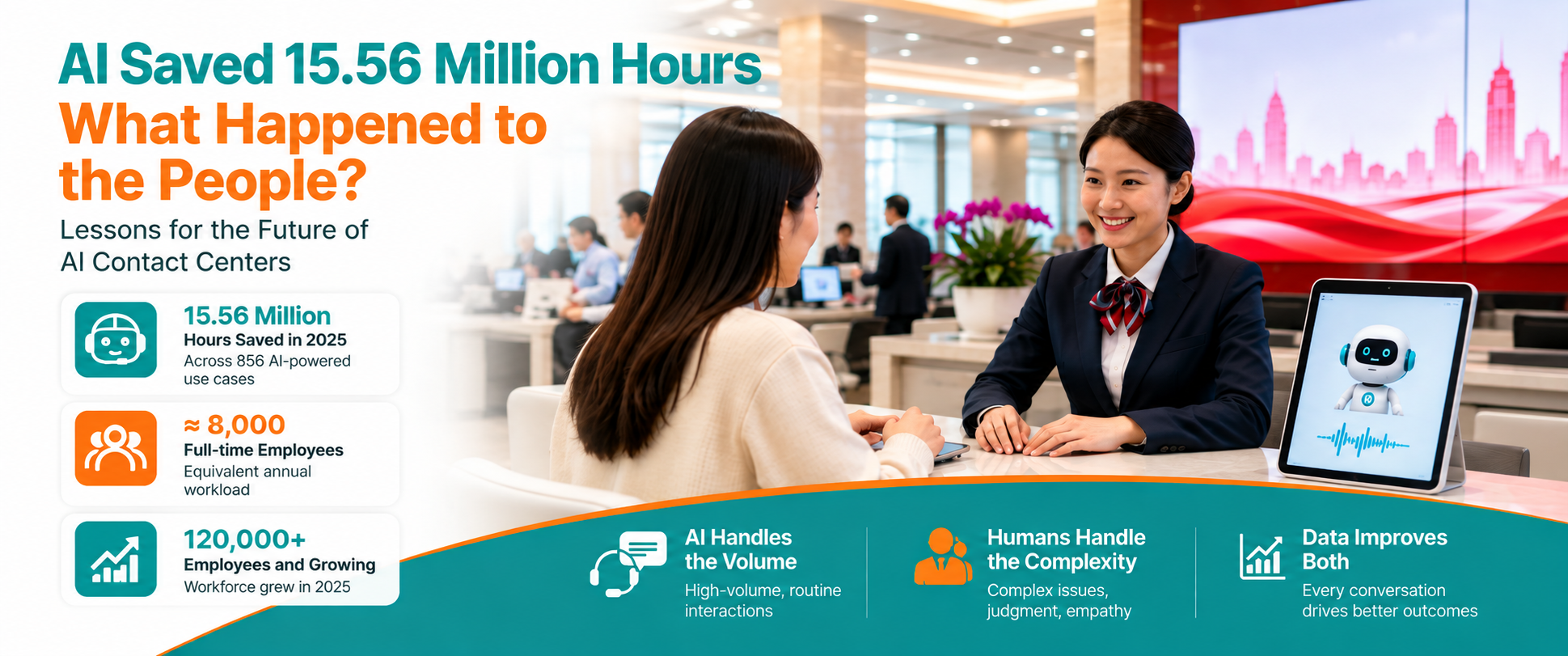
What happens when AI automates the equivalent of thousands of employees’ work?
You might expect the answer to be: fewer employees.
But a recent example from China’s banking industry tells a more interesting story.
China Merchants Bank reported that AI generated 15.56 million hours of labor savings in 2025 across 856 AI-powered use cases — equivalent to roughly 8,000 full-time employees’ annual working hours.
Yet its total workforce continued to grow.
The 15.56 million hours covers AI applications across the bank, not customer service alone. But the story reflects a much bigger transformation now taking place across the contact center industry:
AI isn’t simply replacing human agents. It’s changing what humans and AI each do best.
From AI Tools to AI-First Contact Centers
This shift is already happening.
According to Deloitte Digital’s 2026 Global Contact Center Survey, 35% of contact centers are already using agentic AI as part of their operations. Organizations with mature AI capabilities also reported 85% greater contact center profitability than their low-maturity peers.
Gartner expects this transformation to go even further, predicting that by 2029, agentic AI could autonomously resolve 80% of common customer service issues without human intervention.
But that doesn’t mean the contact center becomes human-free.
In fact, Gartner found that 95% of customer service leaders plan to retain human agents, pointing toward a “digital first, but not digital only” model.
So what does the next-generation AI Contact Center actually look like?
1. AI Handles the Volume
The first layer is customer-facing automation.
AI voice agents, chatbots and virtual agents can increasingly handle high-volume and predictable interactions such as:
Instead of making customers wait for an available agent, AI can respond immediately and operate at scale.
The objective isn't to automate every conversation. It's to automate the conversations that don't require human judgment in the first place.
2. AI Helps Human Agents Handle the Complexity
When a conversation requires a person, AI doesn't disappear.
It changes roles.
This changes the role of the human agent.
Instead of spending time searching for information, typing notes and processing repetitive requests, agents can focus on:
And conversations where empathy and judgment matter.
3. Every Conversation Becomes Data
Perhaps the biggest transformation happens behind the scenes.
Traditional contact centers generate enormous amounts of conversation data, but much of it has historically been difficult to analyze at scale.
AI changes that.
Voice calls, chats and tickets can be automatically transcribed, classified and analyzed to identify:
The contact center therefore becomes more than a service operation.
It becomes a continuous source of customer intelligence.
The Real Question Isn't “How Many Agents Can AI Replace?”
It is:
Which interactions should AI handle autonomously?
Where should AI assist human agents?
And which decisions should always remain with people?
The most effective AI Contact Center strategy is unlikely to sit at either extreme.
Not human-only.
Not AI-only.
Instead:
The companies that get this balance right won't simply build contact centers with fewer repetitive tasks.
They'll build contact centers that are faster, more scalable — and allow human agents to spend more time on the interactions where they create the most value.
- Deloitte Digital — 2026 Global Contact Center Survey
- Gartner — Agentic AI in Customer Service
- Gartner — The Future of Human Agents in Customer Service


